Frequently Asked Questions (FAQ)
Who are we? What is the relationship between Fairfax Matters and Francine Wiig – the community federal candidate in 2025? How you can get involved? Whether you’re curious about our initiatives, seeking ways to contribute, or just want to learn more about the importance of independent representation, you’ll find all the information you need here. If you have any questions please ask one of our volunteers or subscribe to our newsletters or come along to one of our events.
Who are Fairfax Matters?
Fairfax Matters is a community-driven initiative dedicated to empowering residents of the Sunshine Coast to engage in local issues and shape the future of the region. We focus on raising awareness about key concerns, encouraging civic participation, and finding an independent candidate who truly represents the community’s interests. We are a group of parents, grandparents, and young people who are deeply concerned about the future of the Coast and are tired of candidates ignoring community voices. For too long, we have been a safe seat that politicians take for granted. While we may not have the financial resources of the major parties, we have the passion and commitment to make a difference.
Are Fairfax Matters and Francine for Fairfax affiliated with any political party?
No, Fairfax Matters is not affiliated with any political party. We are an independent movement formed by community members who want to see a more representative, accountable, and responsive government.
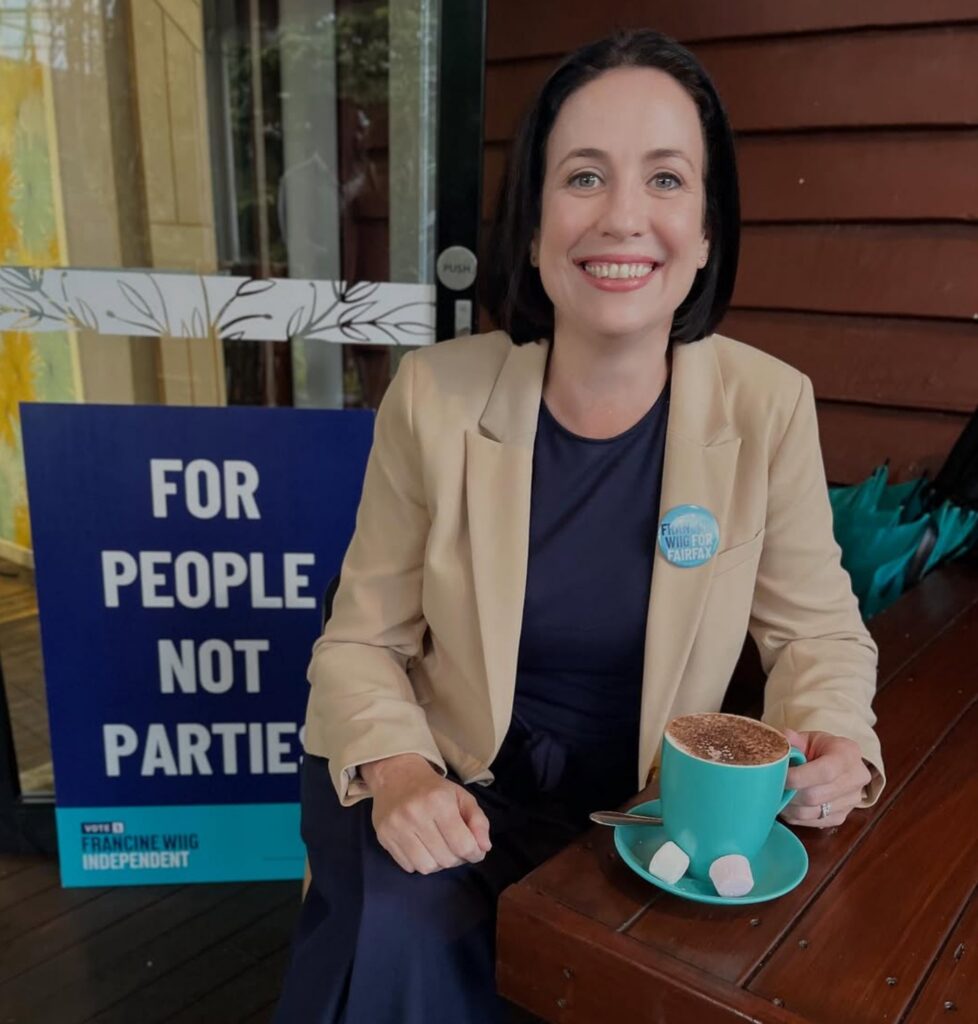
Our Candidate for 2025 was Francine Wiig.
Why is Local representation important?
The Australian federal government controls the allocation of funding for sectors like infrastructure, healthcare, education, and social services, impacting local projects reliant on this support. One key funding area is GST revenue, which the government collects and redistributes to the states. How these funds are allocated can determine if local projects progress or face delays due to funding shortages.
For too long, the Sunshine Coast has been caught in funding battles between state and federal governments, where different parties play against one another, taking advantage of the region’s status as a safe seat.
Stronger local representation in the federal government can ensure that community priorities are heard and funding needs are met, preventing local projects from stalling due to financial gaps or political games.
What are Kitchen Table Conversations?
Kitchen Table Conversations (KTC) are small, informal discussion groups where community members come together to share their views on local issues. We have met in peoples homes, pubs and coffee shops. These conversations help us gather diverse perspectives, understand the concerns of residents, and guide our advocacy efforts. If you would like to host a KTC let us know here.
What are "Teals" or "Community Independents"?
The phrase “Teal independent” is a made up the media coined for a group of Independent community-supported candidates who rose to prominence during the 2022 Federal election, often competing in traditionally safe Liberal seats. These candidates prioritised policies such as climate action, political integrity, and local concerns, with many receiving up to 30% of their campaign funding from Climate 200’s community accelerator program.
Unlike major political parties, which receive significant funding from oil and gas donors, community independents are free from corporate influence. Although Climate 200 provides partial funding, it does not control the candidates’ platforms. These independents focus on serving their constituents, ensuring the community’s needs guide their actions in government.
Francine for Fairfax advocates for this type of grassroots-driven representation, supporting leaders who prioritise the interests of their community without the constraints of party politics.
Don't Independents just vote with the Greens?
No, independents are not part of the Greens or any political party.
By definition, independent representatives are not affiliated with any established political party, including the Greens. They run their campaigns and make decisions based on the specific needs and priorities of their constituents, free from party policies or agendas.
While some of their views or policies might align with those of other parties on certain issues, independents maintain their autonomy and are not bound by any party’s platform or directives.
- With the Greens and Labor: Independents vote with the Greens and Labor when it aligns with their electorate’s core concerns, such as climate action, integrity in politics, and social issues. This collaborative approach prioritizes beneficial policies over party lines, showing they’re flexible and driven by values rather than partisan loyalty.
- With Liberals: Independents vote with Liberals when those votes align with their electorate’s priorities, illustrating their balanced approach and commitment to policies over parties.
How can supporting a community candidate benefit Fairfax's Future?
Supporting an independent can lead to a more inclusive and transparent political process. By electing a representative who is committed solely to the electorate’s well-being, Fairfax can enjoy focused advocacy, direct responsiveness, and policy changes tailored to its specific needs.
Real-world examples of the impact of independents include:
- Climate Action: Independents such as Zali Steggall, who introduced the Climate Change Bill, pushed for stronger legislative frameworks on emissions reduction and climate adaptation. Although initially rejected, it placed significant pressure on the government to elevate climate policies.
- Integrity and Accountability: Helen Haines, representing the electorate of Indi, spearheaded efforts for a federal integrity commission to address corruption and strengthen trust in government. Her advocacy led to increased focus on anti-corruption measures in parliamentary debates.
- Representation and Policy Influence: Independents like Cathy McGowan have used their balance-of-power position to secure regional funding and better services for their constituents. Her work in championing rural health and connectivity demonstrated the power of an independent voice advocating for local needs.
- Higher Education Reform: Monique Ryan, the Independent Member for Kooyong, launched a petition in March 2024 to reform the HECS-HELP debt system. The petition garnered over 288,000 signatures, highlighting widespread concern over student debt indexation. This grassroots effort led to the government announcing a $3 billion reduction in student debt and changes to loan indexation rules, benefiting over three million Australians.
These examples show how independents can drive change, champion critical issues, and ensure the voices of their communities are heard in Parliament. Electing an independent can bring this same dedicated and impactful representation to Fairfax, promoting a government that works for the people.
Why community Independent candidates support Government
An independent can be a strong advocate for their community, raising concerns that might otherwise be overlooked in party-dominated discussions. Independents often hold the balance of power in a hung parliament, allowing them to negotiate and secure significant benefits and funding for their electorates. Additionally, they can work collaboratively with various political parties to support policies that align with community values, pushing for practical and impactful legislative changes without being tied to partisan directives.
Difference between Fairfax Matters and the Candidate Francine Wiig
Fairfax Matters is a community Association, with the objective to select and support a political candidate representing the community. Fairfax Matters is not a political party.
Francine Wiig volunteered to stand as an Independent Candidate. The community of Fairfax Matters provided a volunteer base for her campaign.
What kind of issues does Fairfax Matters focus on?
Fairfax Matters engages with the community to identify and understand key concerns. Through Kitchen Table Conversations and surveys, we have found the following to be the most pressing issues:
– Population Growth
– Housing Affordability & Homelessness
– Infrastructure & Services
– Environmental Protection
– Climate Change
– Governance
We advocate for the issues that matter most to locals, ensuring that their voices are heard and their priorities are addressed – not the priorities of party politics.
Our candidate, Francine Wiig agreed to represent the key concerns and developed policies as part of her campaign.
How is Fairfax Matters Funded?
Fairfax Matters operates as a grassroots, community-led initiative focused on engaging local residents and advocating for issues that matter to the Sunshine Coast. Our activities are funded through a combination of small donations from individuals, fundraising events, in-kind contributions from local businesses, and small grants. We have applied for and successfully received funding from Climate 200 to support one of our initiatives. We rely on the support of volunteers and community members to help organise events and spread our message, and we are committed to maintaining transparency in our operations.
How is Francine Wiig Funded?
We gratefully accept and acknowledge donations to our campaign both locally and from all over Australia from people who align with our values.
As per our 2025 AEC reporting requirements, here is a summary of the AEC record for Francine Wiig – Independent Candidate for the 2025 Federal Election.
- 239 individual donors
- Total gifts / donations received $486,929 (includes both cash and in-kind donations)
- Total electoral expenses $489,958
* (there was some invoices that were incurred prior to 30 June but were not paid until after 30 June – hence a higher expenses number than the donations number)
AEC Transparency website – Francine Wiig
Francine would like to also say a huge thank you to the army of incredible volunteers who danced by the sides of the roads, letterbox dropped, knocked on doors, made phone calls, who showed up at events, who engaged in conversations across our electorate and who volunteered their time at pre-poll and election day booths as well as supported her campaign and continue to do so. This community campaign was powered by people.
Additionally, as part of the AEC disclosure, all candidates are required to disclose donors over the $16,900 threshold.
AEC Transparency website – Donors Over $16,900
Climate 200 donations of $249,187 cover both a component of cash contributions and in-kind (non-cash) donations, which assisted with the costs of:
- lawyers to set up the legal entity,
- accountancy fees to ensure campaigns are not operating from Excel spreadsheets and have professional accountant-verified record-keeping activities,
- help cover the costs of websites, Google and Meta adverts, and marketing
- IT platforms and databases to grow our supporters, volunteer management systems to manage polling booths during elections, and
- support the cost of producing localised artwork designs and campaign marketing.
Extract from Climate 200 website – Climate 200 is a community crowd-funded initiative that supports political candidates committed to our 3 core principles: climate, integrity, and gender equity. Climate 200 is not a party. It does not start campaigns, select candidates, speak for candidates, dictate policies, or have members. We simply give strong community campaigns a leg up with funding and support. (Climate 200 Website Link)
2025 Election – Comparison of donations and expenses to other Independent campaigns
Information extracted from the AEC Transparency Site
| Name | State | Electorate Name | Total Donations | Total Donors | Electoral Expenditure |
| DYSON, Alexander Edward | VIC | Wannon | $ 2,186,936 | 1786 | $ 1,086,054 |
| HEISE, Carolyn Gai | NSW | Cowper | $ 2,141,655 | 55 | $ 1,994,969 |
| RYAN, Monique Marie | VIC | Kooyong | $ 1,905,102 | 3242 | $ 1,874,118 |
| DANIEL, Zoe | VIC | Goldstein | $ 1,834,832 | 1917 | $ 1,795,594 |
| LEONARD, Deborah Louise | VIC | Monash | $ 1,788,961 | 402 | $ 1,597,995 |
| SMITH, Benjamin John | VIC | Flinders | $ 1,786,645 | 641 | $ 1,712,798 |
| SPENDER, Allegra May | NSW | Wentworth | $ 1,743,971 | 1398 | $ 1,900,722 |
| SCAMPS, Sophie Anna | NSW | Mackellar | $ 1,729,956 | 1673 | $ 1,643,292 |
| CHANEY, Katherine Ella | WA | Curtin | $ 1,484,647 | 1513 | $ 1,460,873 |
| MURRAY-BARTLETT, Erchana | QLD | McPherson | $ 1,271,066 | 221 | $ 1,250,550 |
| HOOK, Kathleen Louise | NSW | Calare | $ 1,023,794 | 462 | $ 838,435 |
| SMITH, Eleanor | QLD | Dickson | $ 931,233 | 1316 | $ 919,197 |
| STEGGALL, Zali | NSW | Warringah | $ 789,736 | 1421 | $ 726,737 |
| CHAPMAN, Susan Margaret | WA | Forrest | $ 730,403 | 360 | $ 569,654 |
| JONES, Keryn Louise | QLD | Fisher | $ 690,652 | 205 | $ 730,676 |
| MILLER, Jeremy John | NSW | Lyne | $ 646,446 | 172 | $ 522,087 |
| HAINES, Helen Mary | VIC | Indi | $ 629,318 | 1006 | $ 686,468 |
| KUSS, Anita | SA | Grey | $ 624,183 | 106 | $ 588,140 |
| WIIG, Francine Clare | QLD | Fairfax | $ 486,929 | 239 | $ 489,958 |
| HOLT, Suzanne Jan | QLD | Groom | $ 404,715 | 132 | $ 376,089 |
| HULETT, Kate Jane | WA | Fremantle | $ 366,779 | 216 | $ 400,258 |
| GEORGE, Peter Antony | TAS | Franklin | $ 345,777 | 212 | $ 332,566 |
| BROWN, Tina | NSW | Berowra | $ 343,817 | 137 | $ 239,825 |
| FERRES MILES, Claire Jennifer | VIC | Casey | $ 332,181 | 202 | $ 382,323 |
| MOORE, Carly Anne | VIC | Calwell | $ 319,091 | 87 | $ 333,059 |
| MILTHORPE, Michelle Marie | NSW | Farrer | $ 283,506 | 252 | $ 278,872 |
| SCOTT, Phillip Stephen | NT | Solomon | $ 278,977 | 300 | $ 219,032 |
| YIN, Andy | NSW | Bradfield | $ 253,246 | 72 | $ 283,359 |
| DEZARNAULDS, Katherine Louise | NSW | Gilmore | $ 245,847 | 239 | $ 261,069 |
| COOPER, Verity Jane | SA | Sturt | $ 234,666 | 303 | $ 265,829 |
| PRICE, Jessie Ann | ACT | Bean | $ 210,345 | 214 | $ 230,285 |
| KOUTOUFIDES, Anthony | VIC | Melbourne | $ 177,174 | 23 | $ 177,174 |
| OUF, Ahmed Ibrahim Ali | NSW | Blaxland | $ 173,112 | 129 | $ 173,112 |
| BARTON, Nathan | WA | Moore | $ 169,348 | 116 | $ 192,811 |
| ARROWSMITH, Nicole | QLD | Moncrieff | $ 119,523 | 99 | $ 151,645 |
| BASYOUNY, Ziad | NSW | Watson | $ 116,631 | 147 | $ 266,006 |
| ROLFE, Jenny Lee | NSW | Riverina | $ 103,645 | 56 | $ 92,982 |
2025 Disclosures within Fairfax
Note that parties get funding from their national campaigns and are not disclosed on an electorate basis. The LNP campaign raised $214 million, and Labor $159 million. On a pro-rata basis (150 seats) is $1.5 million per seat. The Australian Federation Party received $54 million from Clive Palmer’s Mineralogy and spent about $200 million.
| Name | Party Name | Total Donations | Total Donors | Electoral Expenditure |
| ETHERIDGE, Susan Edith | Queensland Greens | $ – | 0 | $ – |
| MARSH, Beatrice Josephine | Pauline Hanson’s One Nation | $ – | 0 | $ 10,694 |
| McKEOWN, Paul John | Independent | $ 1,270 | 6 | $ 13,137 |
| McQUEEN, Naomi Sharyn | Australian Labor Party (State of Queensland) | $ – | 0 | $ – |
| O’BRIEN, Edward Lynam | Liberal National Party of Queensland | $ – | 0 | $ – |
| RYZY, Gregory Danny | Australian Federation Party | $ 2,828 | 1 | $ – |
| SANDERSON, Rhys Paul | Family First Party Australia | $ – | 0 | $ – |
| WIIG, Francine Clare | Independent | $ 486,929 | 239 | $ 489,958 |
Information extracted from AEC
Big Donors
For information about where the money came from? Read more here
Why Are You Running?
Like many people, I’m frustrated with the lack of action from our major parties. I can’t help but wonder how will my children afford to move out of home or pay for university? Instead of tackling real issues, the major parties are more focused on staying in power than delivering solutions for us.
I believe politics should be about people, not parties. Running as an independent means I am free from party lines and special interests, allowing me to truly represent the needs and concerns of the Fairfax community. I want to be a strong voice for locals, prioritising real solutions over political games.
What are Francine's Key Priorities
My campaign in 2025 was built around the issues that matter most to the people of Fairfax. They are not limited to the following:
- Cost of Living Relief – I will advocate for policies that ease financial pressures on families, including fair wages, energy affordability, and support for local businesses.
- Housing and Infrastructure – I will push for smart, sustainable development to ensure affordable housing and better public transport options for our growing Sunshine Coast community.
- Better Representation – I will listen to the community and take your voices directly to Canberra, ensuring that Fairfax isn’t overlooked in national decision-making.
- Environmental Action – I am committed to protecting our beaches, parks, and waterways by supporting renewable energy and climate-resilient infrastructure.
- Health and Wellbeing – I will work to strengthen local healthcare services and improve access to GPs.
What Preferences Did Francine Direct to in 2025?
Francine did not direct preferences. Her how-to-vote card stated ‘Vote 1 Francine Wiig’ and encourage voters to number every box according to their own preferences. Francine states “I trusted the voters of Fairfax to make their own decisions and believe in empowering individuals to have full control over where their preferences go.”
How Does Preferential Voting Work and Why is it Important?
Australia uses a preferential voting system, meaning that instead of choosing just one candidate, voters rank candidates in order of preference by numbering every box on the ballot.
If no candidate wins more than 50% of the primary vote, the candidate with the fewest votes is eliminated, and their votes are redistributed to the voter’s next preference. This process continues until one candidate reaches a majority.
Why is this important?
- It ensures that every vote counts, even if your first-choice candidate doesn’t win.
- It prevents vote splitting and gives independent candidates like me a real chance.
- It allows voters to choose who represents them, rather than just voting against someone.
What Is a Community Backed Independent
A community-backed independent is a political candidate who isn’t part of a political party. Instead of answering to party bosses or donors, they are supported by everyday people from their community through time, donations, and shared values.
They listen first, act with integrity, and are accountable to the people they represent. Community independents are often powered by grassroots campaigns, volunteers, and local voices who want to see politics done differently with transparency, collaboration, and real action on the issues that matter locally.
At the 2022 federal election, 10 independents were elected to the House of Representatives.
In 2025, Community Independents stood in 37 of 150 electorates, across every Australian State and Territory, and a Community Independent Senator in the ACT.
(Source: Australian Electoral Commission)